
-2019 Archive
-2018 Archive
Rainer Glaser
Professor of Chemistry and Interim Vice Provost of Graduate Education
573-341-6805 | glaserr@mst.edu |
216 Centennial Hall, Rolla, MO
Quad Chart
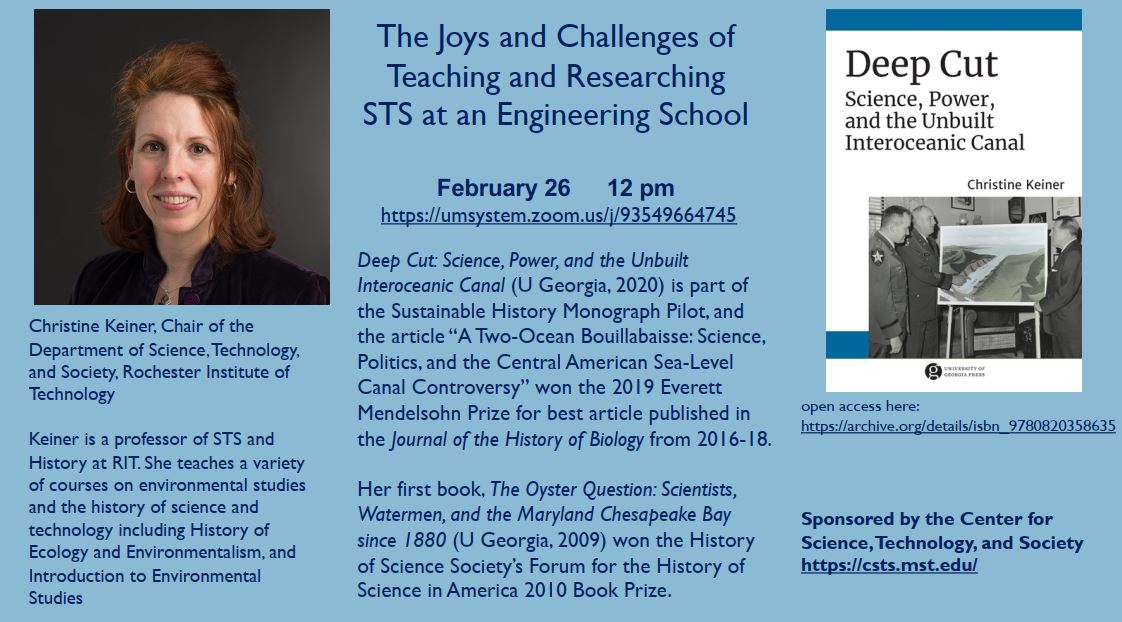
The Joys and Challenges of Teaching and Researching STS at an Engineering School - February 26 12 pm
With Christine Keiner, Chair of the Department of Science, Technology,and Society, Rochester Institute of Technology
Deep Cut: Science, Power, and the Unbuilt Interoceanic Canal (U Georgia, 2020) is part of the Sustainable History Monograph Pilot, and the article “A Two-Ocean Bouillabaisse: Science, Politics, and the Central American Sea-Level Canal Controversy” won the 2019 Everett Mendelsohn Prize for best article published in the Journal of the History of Biology from 2016-18.
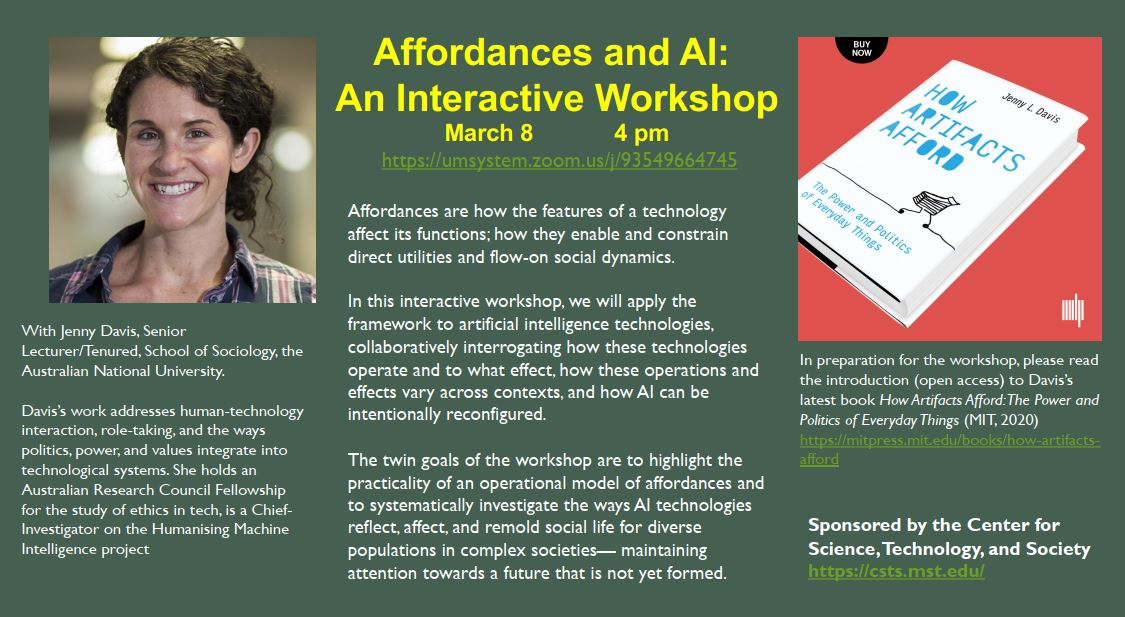
Affordances and AI: An Interactive Workshop -March 8, 2020 4 pm
With Jenny Davis, Senior Lecturer/Tenured, School of Sociology, the Australian National University.
Affordances are how the features of a technology affect its functions; how they enable and constrain direct utilities and flow-on social dynamics.
In this interactive workshop, we will apply the framework to artificial intelligence technologies, collaboratively interrogating how these technologies operate and to what effect, how these operations and effects vary across contexts, and how AI can be intentionally reconfigured.
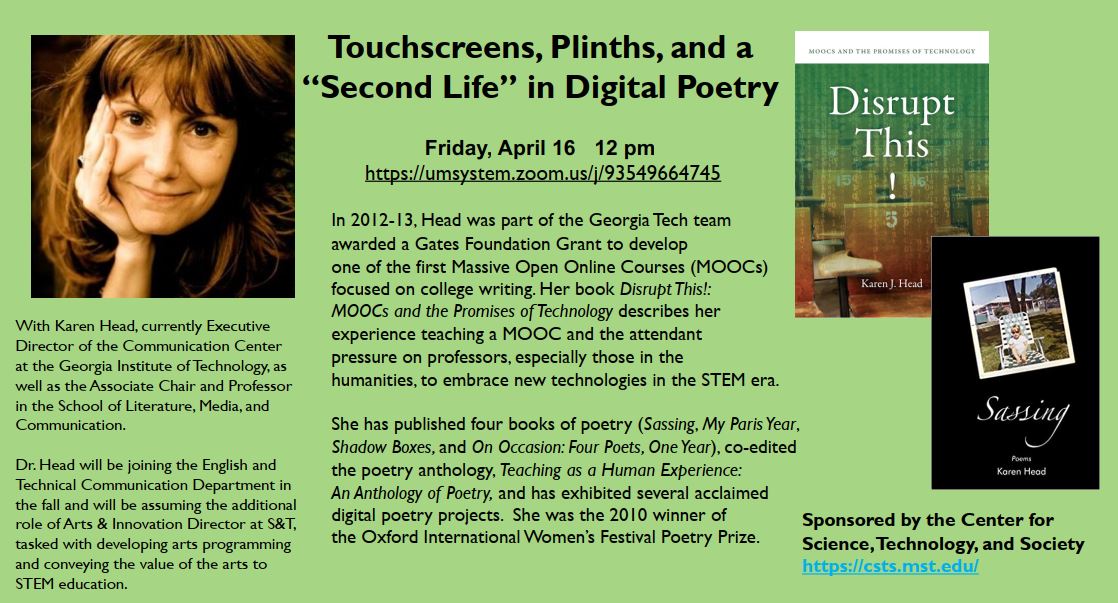
Touchscreens, Plinths, and a “Second Life” in Digital Poetry - Friday, April 16 12 pm
With Karen Head, currently Executive Director of the Communication Center at the Georgia Institute of Technology, as well as the Associate Chair and Professor in the School of Literature, Media, and Communication
In 2012-13, Head was part of the Georgia Tech team awarded a Gates Foundation Grant to develop one of the first Massive Open Online Courses (MOOCs) focused on college writing. Her book Disrupt This!: MOOCs and the Promises of Technology describes her experience teaching a MOOC and the attendant pressure on professors, especially those in the humanities, to embrace new technologies in the STEM era.
Touchscreens, Plinths, and a “Second Life” in Digital Poetry Flyer
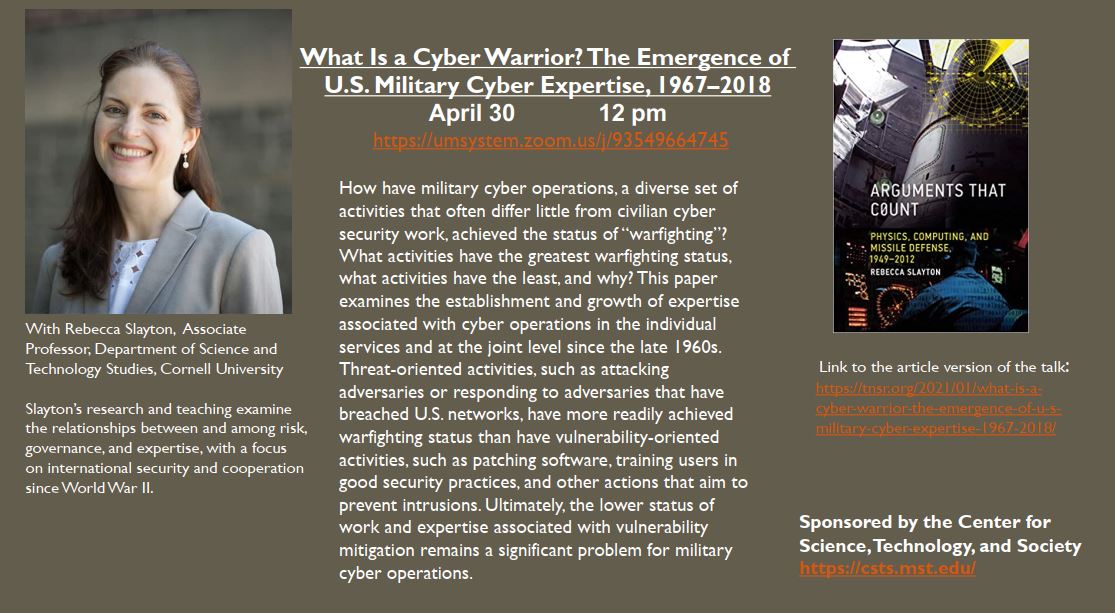
What is a Cyber Warrior? The Emergence of U.S. Military Cyber Expertise, 1967-2018- April 30 12 pm
With Rebecca Slayton, Associate Professor, Department of Science and Technology Studies, Cornell University
How have military cyber operations, a diverse set of activities that often differ little from civilian cyber security work, achieved the status of “warfighting”? What activities have the greatest warfighting status, what activities have the least, and why? This paper examines the establishment and growth of expertise associated with cyber operations in the individual services and at the joint level since the late 1960s.
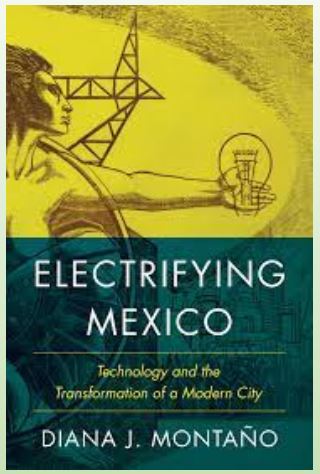
Policing Electricity: Power Theft and Everyday Life in Mexico City, 1901-1918
November 10, 2021 2 pm
https://umsystem.zoom.us/j/4757708789
Diana J. Montaño's research interests include the construction of modern Latin American societies with a focus on technology and its relationship to nationalism, everyday life and domesticity. Her first book Electrifying Mexico: Technology and the Transformation of a Modern City examines how ordinary citizens used electricity, both symbolically and physically, in the construction of a modern nation. The book weaves together how these "electrifying agents" first crafted a discourse for an electrified future and secondly, how they shaped its consumption. It shows how these agents of modernity promoted and created both imaginary and tangible notions of this technology. Taking a user-based perspective, this study reconstructs how electricity was lived, consumed, rejected, and shaped in everyday life.
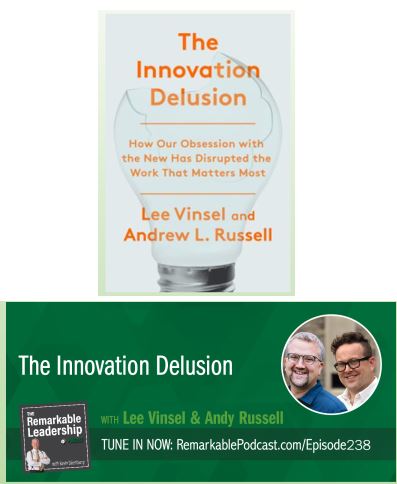
The Innovation Delusion: How Our Obsessions with the New Has Disrupted the Work thatMatters Most
December 2, 2021 1 pm
https://umsystem.zoom.us/j/4757708789
Since the 1950s, we have literally heard the word "innovation" more and more every year. But is this innovation-speak getting us what we want? In this talk, I will examine the history of innovation-speak, argue that it isn't getting us more innovation and comes with serious costs, including distracting us from important issues like maintenance and repair. I will outline some of the ideas of The Maintainers community, which has been thinking about these topics for the past six years. The Maintainers is a global, interdisciplinary research network focused on maintenance, repair, and the mundane work that keeps our world going.
CSTS Symposium
September 24, 2021
The Futures of STS in Engineering and Polytechnic Universities
What does the future of STS look like in engineering and polytechnic universities? In such STEM-focused environments, where STS scholars often operate independently and without a central STS department or program, how can STS researchers maximize their impact on the education of undergraduate and graduate students, as well as on the original research conducted by (and often financially supported by) colleagues in engineering departments? How can STS researchers become indispensable to engineering and scientific research endeavors without being perceived as simply support personnel? Assembling convergent research teams to tackle important social and scientific challenges is an acknowledged best practice, so how should STS researchers embrace convergent research endeavors in order to add value and lead inquiries into areas of new and developing knowledge?
Please register for each panel individually by clicking on the registration links in the Symposium Program below.
*ALL TIMES IN CENTRAL US